


Getting your audio player ready…
Archaeologists excavating the legendary city of Troy have unearthed what experts are calling one of the most significant archaeological discoveries at the site of the past century. The remarkable find includes a pristine 4,500-year-old gold brooch, a rare jade stone, and a bronze pin, all dating to approximately 2,500 BC during the Early Bronze Age. This extraordinary discovery not only represents one of only three known examples of such brooches worldwide but also resolves decades of scholarly debate about Troy’s chronological framework.
The artifacts were discovered within the stratigraphic layers of Troy II, providing archaeologists with definitive evidence that this settlement phase began around 2,500 BC rather than the previously debated dates of 2,300-2,200 BC. Turkey’s Culture and Tourism Minister Mehmet Nuri Ersoy announced the discovery, emphasizing its global importance and describing the brooch as “the best-preserved example of its kind” among only three known worldwide parallels.

4,500-year-old gold brooch unearthed during excavations at the ancient city of Troy in Canakkale, Turkey. (Turkey’s Ministry of Culture & Tourism)
Luxury and Status in the Bronze Age
The gold brooch represents far more than mere ornamentation; ring-shaped brooches of this period functioned as both practical garment fasteners and powerful symbols of social status and prestige. The exceptional preservation of this particular example allows researchers to study intricate craftsmanship techniques that have rarely survived the millennia.
Accompanying the brooch, archaeologists uncovered an equally remarkable jade stone, believed to have served as a ring component or decorative element. Jade was extraordinarily rare in Anatolian archaeological contexts, making this discovery particularly significant for understanding Bronze Age trade networks and luxury consumption patterns. The presence of jade at Troy suggests the city’s inhabitants participated in extensive long-distance trade relationships, importing precious materials from distant regions to satisfy elite demand for exotic goods notes Türkiye Today.
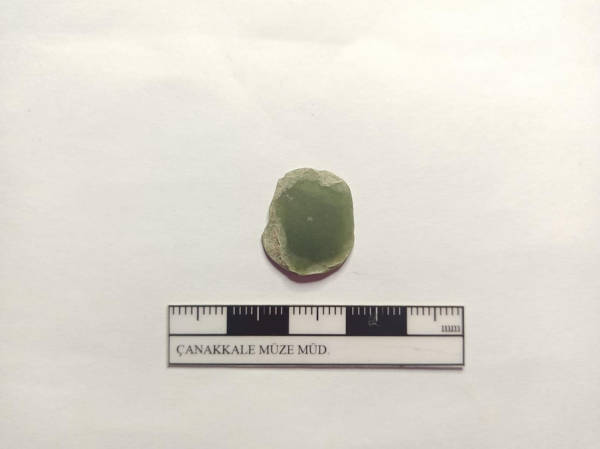
Jade stone found at Çanakkale, Turkey. (Turkey’s Ministry of Culture & Tourism)
Resolving Archaeological Debates
This discovery represents a breakthrough moment for Troy archaeology, finally providing concrete chronological evidence for one of the site’s most debated periods. For decades, scholars have argued over the precise dating of Troy II, with estimates ranging between 2,300 and 2,200 BC. The newly discovered artifacts, found in clearly defined stratigraphic contexts, definitively establish the Troy II settlement phase as beginning around 2,500 BC, pushing back the city’s Early Bronze Age timeline by several centuries.

Brutus of Troy & the Myth of Britain’s Trojan Origins, from the Ancient Origins Store
This refined dating helps archaeologists better understand the broader cultural and technological developments across ancient Anatolia during the third millennium BC. Troy’s role as a strategic hub connecting the Aegean and Black Sea regions becomes clearer when viewed through this updated chronological framework, revealing how the city participated in and influenced regional development patterns throughout the Early Bronze Age reports the Anadolu Agency.
The bronze pin discovered alongside the gold brooch and jade stone provides additional insights into ancient metalworking techniques and daily life practices. Bronze pins served essential functions in ancient clothing systems, and their presence in the same archaeological context as luxury items suggests this may have been a high-status burial or ceremonial deposit.
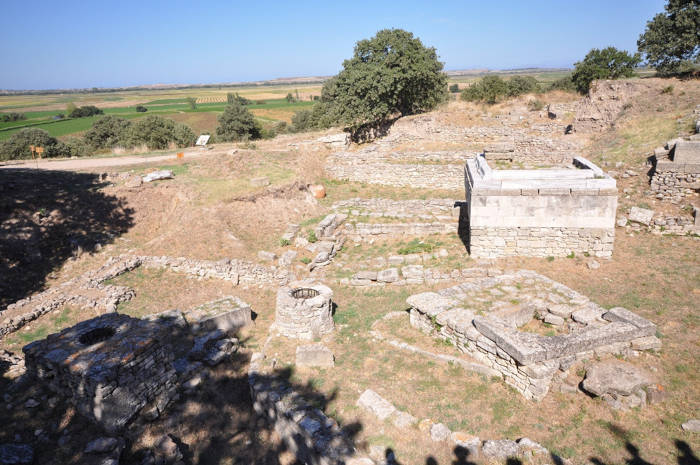
Archaeological site of Troy in Turkey showing ancient stone walls and ruins. (Jorge Láscar/CC BY 2.0)
From Excavation to Exhibition
Following Turkey’s policy of displaying archaeological artifacts in their regions of discovery, these remarkable treasures will soon be exhibited at the Troy Museum in Çanakkale. Opened in 2018, the museum already houses thousands of artifacts spanning Troy’s long history from the Early Bronze Age through the Byzantine period.
The discovery represents the culmination of over 160 years of continuous archaeological investigation at Troy, beginning with Heinrich Schliemann’s famous excavations in the 19th century. Modern archaeological techniques have allowed researchers to identify at least nine major settlement layers (Troy I through Troy IX), each representing different periods of occupation spanning from the Early Bronze Age to the Byzantine era.
The finds also demonstrate how archaeological research at Troy continues to bridge the gap between legendary narratives and historical reality. While Homer’s Iliad immortalized Troy in literature, these tangible discoveries provide concrete evidence of the city’s actual prosperity, sophistication, and cultural significance during the Bronze Age. The exceptional craftsmanship evident in the gold brooch, combined with the presence of exotic materials like jade, reveals a society capable of supporting skilled artisans and participating in complex trade networks spanning vast distances.
Top image: Gold brooch found at the Trot archaeological site in Çanakkale, Turkey. Source: Turkey’s Ministry of Culture & Tourism
By Gary Manners
References
Arkeonews. 2025. 4,500-Year-Old Gold Brooch Unearthed in Troy: One of Only Three Known Examples Worldwide. Available at: https://arkeonews.net/4500-year-old-gold-brooch-unearthed-in-troy-one-of-only-three-known-examples-worldwide/
Anadolu Agency. 2025. 4,500-year-old golden brooch, rare jade unearthed at ancient Troy in Türkiye. Available at: https://www.aa.com.tr/en/culture/4-500-year-old-golden-brooch-rare-jade-unearthed-at-ancient-troy-in-turkiye/3700986
Türkiye Today. 2025. 4,500-year-old gold brooch, jade stone found in Troy among century’s most important discoveries. Available at: https://www.turkiyetoday.com/culture/4500-year-old-gold-brooch-and-jade-stone-found-in-troy-among-centurys-most-important-3207627

