


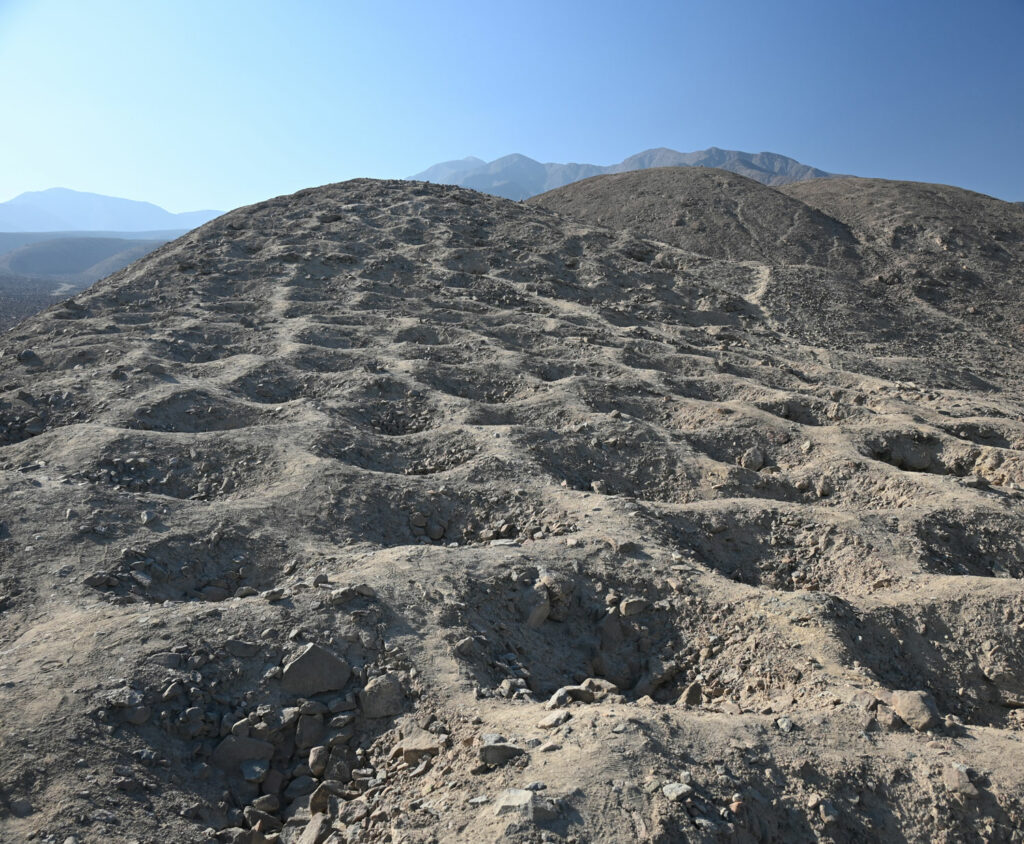
SYDNEY, AUSTRALIA—According to a statement released by the University of Sydney, a team of researchers led by digital archaeologist Jacob Bongers has mapped the more than 5,000 aligned holes on Monte Sierpe in southern Peru’s Pisco Valley with drone technology. They found that the arrangement of the so-called “Band of Holes” is similar to at least one Inca Khipuan accounting device made of knotted string, discovered in the same valley. The researchers also analyzed soil from the holes and identified maize pollen and traces of reeds that were used for weaving baskets. Bongers suggests that people of the pre-Inca Chincha Kingdom may have carried plants to the site in baskets and then placed them in the holes. Merchants, fisherfolk, and cotton farmers may have also met here to do business, he added. “We know the pre-Hispanic population here was around 100,000 people,” Bongers said. Later, under Inca rule, the researchers think the monument may have been used for accounting as a sort of “landscape khipu,” noting that it was situated between the highlands and coastal plain, and was near two Inca administrative sites and a network of pre-Hispanic roads. “There are still many more questions—why is this monument only seen here and not all over the Andes?” Bongers said. Read the original scholarly article about this research in Antiquity. To read more about the “Band of Holes,” go to “An Overlooked Inca Wonder.”
The post Drone Mapping Offers Insight into Peru’s “Band of Holes” appeared first on Archaeology Magazine.

