


Getting your audio player ready…
New research challenges the centuries-old assumption that the world’s most famous illuminated manuscript, the Book of Kells, was created on the Scottish island of Iona. Instead, Dr. Victoria Whitworth’s forthcoming study suggests the magnificent 1,200-year-old Gospel book was crafted in Pictish eastern Scotland, specifically at the monastery of Portmahomack in Easter Ross, revolutionizing our understanding of medieval Scottish culture and manuscript production.
The Book of Kells, containing intricate illuminated accounts of the four Gospels of Matthew, Mark, Luke and John, has long been considered Ireland’s greatest cultural treasure. Traditional scholarship placed its origins at the monastery on Iona before its transfer to the monastery of Kells in County Meath, Ireland, following Viking raids in the 9th century.
Archaeological Evidence Supports Pictish Origins
Dr. Whitworth’s research centers on archaeological findings at Portmahomack, a major Pictish monastery that flourished from approximately 700 to 800 AD before its destruction by fire, possibly during a Viking raid. The site revealed compelling evidence of sophisticated manuscript production, including monks manufacturing vellum – the calfskins used for writing – alongside creating elaborate stone carvings with complex inscriptions that match those found in the Book of Kells explains The Guardian.
“The Picts were great artists, producing highly sophisticated Christian sculpture, but it has generally been accepted that not a single Pictish manuscript survives,” Whitworth explained. “If the Book of Kells was made in Pictland, this rewrites our understanding of early medieval Scotland.” Remarkably, archaeologists discovered a fine sculptor’s chisel at the site’s vellum workshop, suggesting that book-making and stone-carving were intimately interconnected crafts.
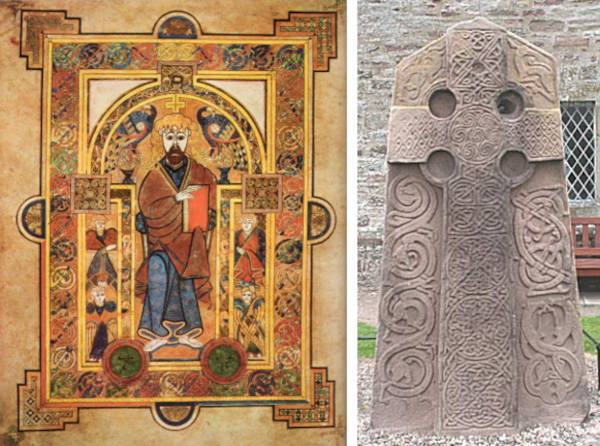
Left, Illuminated page from the Book of Kells showing intricate Celtic artwork and detailed manuscript illumination. Right, Pictish stone carving, demonstrating the sophisticated artistic capabilities that parallel the Book of Kells’ elaborate designs. (Left, Public DomainRight; Anne Burgess/CC BY-SA 2.0)
Comparing Artistic Traditions Across Britain
The key evidence lies in comparing artistic traditions. Whitworth points to stone carvings at Portmahomack, particularly a fragment now in the National Museums Scotland, whose Latin inscription shows remarkable parallels with the Book of Kells text. “It is the most elaborate piece of carved stone from anywhere in the early Middle Ages in the British Isles,” she noted, highlighting “a long Latin inscription in relief, very beautiful lettering that’s very similar to Kells – these fabulous display capitals.”
This contrasts sharply with Iona’s stone sculpture which, while high quality, “lacks this endless inventiveness and unpredictability” characteristic of both Kells and Pictish art. Additionally, previous scholars noted that the manuscript’s script resembles Northumbrian styles more than Irish traditions, supporting connections to northeastern Scotland where Northumbrian monks mentored Pictish communities.
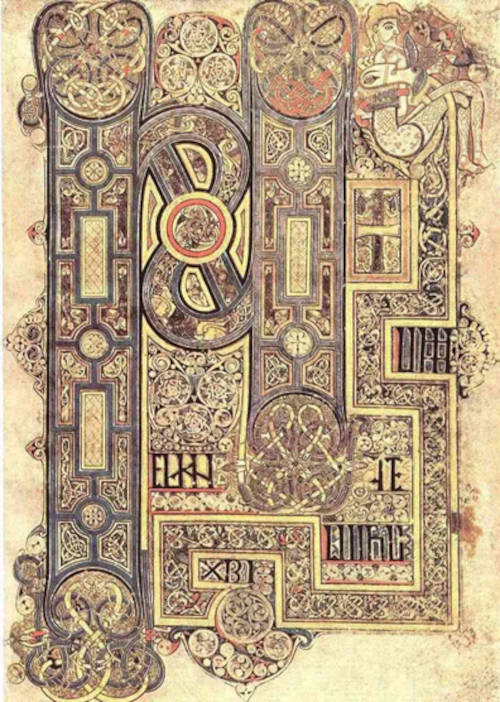
Ornate initial from the Book of Kells displaying the characteristic “endless inventiveness” that parallels Pictish artistic traditions. (Public Domain)
Challenging Academic Assumptions
Whitworth’s arguments also address timing inconsistencies in traditional theories. The monastery at Kells was founded in 807 AD but didn’t become important until the later ninth century – too late for the Book of Kells’ creation period. Meanwhile, Portmahomack was discovered only in the 1990s through excavations led by Professor Martin Carver, meaning earlier scholars lacked a suitable Pictish monastery to consider as an alternative origin point.
“The Picts had suffered for many decades from being seen as mysterious, remote and backward,” Whitworth observed. “If you just look at the archaeology of our top early medieval monasteries, Portmahomack stands out as exceptionally literate and book-oriented.” Her research suggests scholars should “flip that on its head and say that the Book of Kells is actually an exceptionally Pictish-looking manuscript.”
However, Professor Rachel Moss from Trinity College Dublin cautions against definitive conclusions, noting that:
“during the period when the Book of Kells was made, there is lots of evidence of the movement of holy men, artists, objects and materials across Ireland, Britain and the continent. Unless actually recorded in a manuscript, it is nearly impossible to pinpoint where it was made, or by whom.”
Dr. Whitworth will present her complete findings in “The Book of Kells: Unlocking the Enigma,” published by Head of Zeus in October 2025, potentially rewriting one of medieval Europe’s greatest cultural mysteries.
Top image: The Book of Kells is written in majuscule insular script, in yellow, red, purple, and black ink. Source: Warren Rosenberg / Adobe Stock
By Gary Manners
References
Moss, R. 2025. New research may rewrite origins of the Book of Kells, says academic. Available at: https://www.theguardian.com/books/2025/sep/26/new-research-may-rewrite-origins-of-the-book-of-kells-says-academic
Whitworth, V. 2025. The Book of Kells: Unlocking the Enigma. Head of Zeus.

