


Getting your audio player ready…
In a rare occurrence, eleven medieval rings and two medallions have emerged from the most unlikely of places – a Canadian thrift store shelf. The artifacts, which experts believe could date back to the fourth or fifth century AD, were discovered at Thrifty Boutique in Chilliwack, British Columbia, priced at just $30 each before being recognized by a sharp-eyed archaeology enthusiast.
The remarkable find has now captured the attention of researchers at Simon Fraser University, who face the challenging task of determining not only the age and origin of these mysterious pieces but also grappling with the ethical implications of studying artifacts with no documented provenance.
From Donation Box to Archaeological Investigation
The story began in spring 2024 when an anonymous donor left the collection of jewelry at Thrifty Boutique, a store operated by Chilliwack Hospice. Store manager Sandy Parker initially treated them as typical costume jewelry, pricing each piece at $30 reports CBC News. However, fate intervened when a patron with archaeological training examined the items more closely and immediately recognized their potential historical significance.
Associate Professor Sabrina Higgins from SFU’s Museum of Archaeology & Ethnology conducted the initial assessment.
“The shapes, designs and construction make me think that these are medieval, as the Romans typically used slightly different materials and techniques,” Higgins explained. Her preliminary analysis suggests the artifacts likely originated from somewhere within the former Western Roman Empire, though more detailed study is required for definitive dating reports SFU NEWS.
Academic Opportunity Meets Ethical Dilemma
The discovery presents SFU with both an exceptional educational opportunity and a complex ethical challenge. The university’s Museum of Archaeology & Ethnology typically refuses artifacts without proper documentation, as undocumented pieces risk being stolen or illegally looted materials. Assistant Professor Cara Tremain outlined their concerns:
“What if they were looted from their original archaeological site? Looting leads to the loss of cultural and scientific knowledge” quotes All That’s Interesting.
Despite these concerns, the university ultimately decided to accept the artifacts, recognizing their potential educational value. The pieces will become the centerpiece of a new archaeology course launching in fall 2026, where students will systematically analyze each item to determine authenticity, age, and possible origins. This hands-on approach will provide invaluable training in artifact analysis while potentially solving the mystery of their provenance.
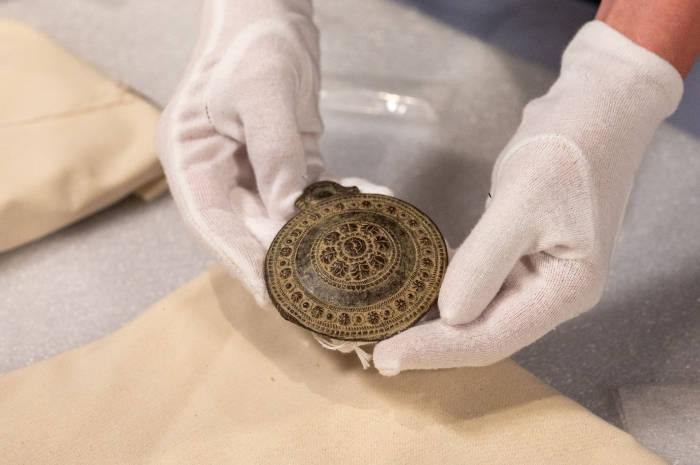
One of the medallions discovered at the thrift shop. (Sam Smith/SFU)
Educational Value Regardless of Authenticity
Professor Higgins emphasizes that even if the artifacts prove to be modern forgeries, they will still serve important educational purposes.
“Even if these end up being forgeries, there’s still an interesting learning experience for the students in terms of going through an object systematically to determine whether it’s real, or a forgery, and questioning why forgeries continue to make their way into the antiquities market,” she noted.
The comprehensive analysis will employ cutting-edge research technologies available within SFU’s archaeology department. Students will learn to examine construction techniques, material composition, and stylistic elements that can reveal an artifact’s true age and origin. This process typically takes at least a semester, making it an ideal long-term project for developing crucial archaeological skills.
The case highlights broader issues within archaeology regarding undocumented artifacts and the antiquities market. While the thrift store discovery is certainly unusual, it underscores the importance of proper documentation and ethical acquisition practices in preserving our cultural heritage for future generations.
Top image: Medieval ring artifact showing detailed metalwork and potential historical significance. Source: SFU/Museum of Archaeology & Ethnology
By Gary Manners
References
CBC News. 2025. B.C. thrift store doesn’t know who donated possible medieval artifacts. Available at: https://www.cbc.ca/news/canada/british-columbia/medieval-artifact-chilliwack-thrift-store-1.7642973
Brown, A., 2025. Rare Artifacts Believed To Be From The Middle Ages Mysteriously Found At A Canadian Thrift Stor.e Available at: https://allthatsinteresting.com/chilliwack-canada-thrift-store-medieval-artifacts
Smith, S., 2025. Rare ‘medieval’ artifacts found in B.C. thrift store donated to SFU for study. Available at: https://www.sfu.ca/sfunews/stories/2025/09/rare–medieval–artifacts-found-in-b-c–thrift-store-donated-to-.html

