



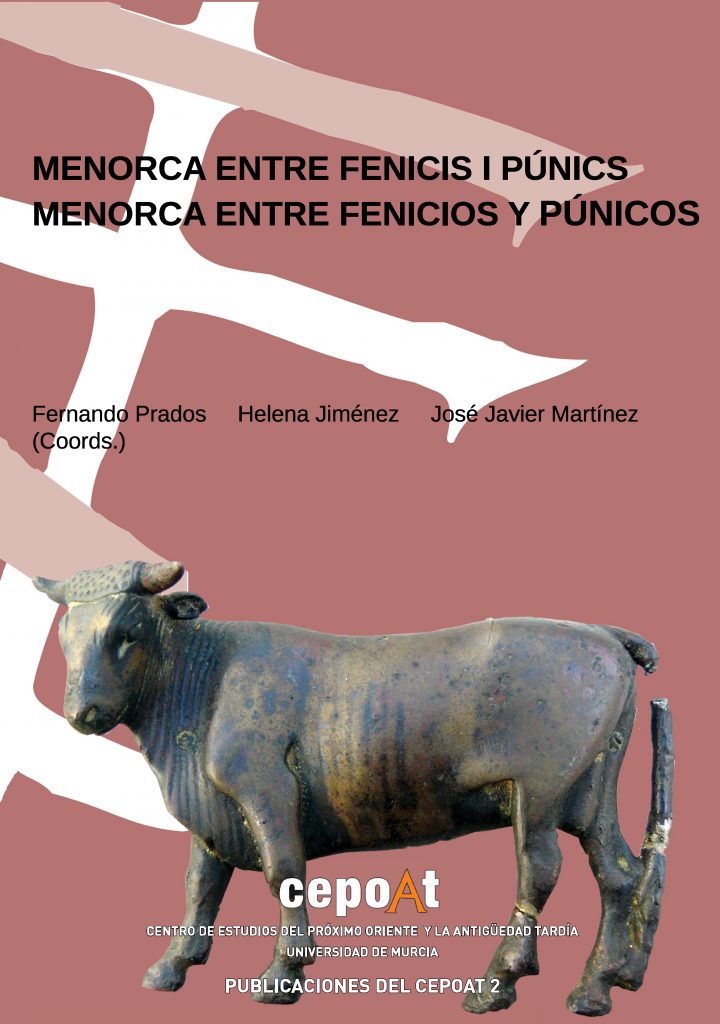
Fernando Prados
Helena Jiménez
José Javier Martínez
(Coords.)
ISBN: 978-84-946637-0-3
322 pages
CEPOAT Monographs
Published: 15-1-2017
Content:
- Presentation.
- Prologue.
- From gray to white. The island of Menorca on the Phoenician and Punic map.
- Hannibal’s army, a force of mercenaries.
- Shipwrecks and colonies? Punic materials in the Balearic Islands.
- New Data on the formal and stylistic evolution of the “female head-shaped cauldrons.” Regarding the specimen from Torralba d’en Salord (Alaior, Menorca).
- Menorca between Phoenicians and Punics: an archaeological approach from defensive architecture.
- Cultural continuity in the time of change: the production and preparation of food in Cornia Nou (Maó, Menorca) during the 4th-III centuries BC.
- Grants of a Punic-Talayotic Sanctuary in the village of Biniparratx Petit (Sant Lluís, Menorca).
- Archaeological survey in Torrellafuda (Ciutadella, Menorca). Meeting Punic Menorca.
- Evidence of external contacts to the Talayotic world from the study of the Fauna Register.
- Punic glass of glass paste in Menorca: The set of Circle 7 of Torre d’en Galmés.
- Menorcan cercles: approach to the influence of Punic architecture in the post-layotic homes of Menorca.
- Ba’al-Hammon, Caelestis and the god of the full moon in the sanctuary with taula of Son Catlar (Ciutadella).
- Literature.
Summary: This volume concludes various scientific studies and the results of various research projects that are currently being developed in the fertile Menorcan archaeological terrain. The coordinators of the work, Fernando Prados (University of Alicante), Helena Jiménez (CNRS – University of Toulouse) and José J. Martínez (University of Murcia) are part of the MODULAR project, which has as its main object of study the Phoenician-Punic world from its architectural manifestations. MODULAR pays special attention to the connection between the Phoenician-Punic world and local cultures, evaluating the resulting hybridization and miscegenation processes. Among the study and analysis laboratories, Menorca stands out, especially in its post-talayotic phase. The aforementioned project is part of a priority line of research that is developed by the Institute of Archeology of the University of Alicante and has the support of the Consell Insular de Menorca, within its aid program for carrying out archaeological interventions, the City Council of Ciutadella, the SHA Martí i Bella and Camping Cap Blanch, from various collaborative figures ranging from logistical support to patronage.
